Two thousand years ago the Roman engineer Vitruvius wrote that a well-proportioned human body could be inscribed in both a circle and a square. He never said how large one should be relative to the other. Without that, the problem has no single answer — which is why, over the past century, scholars have proposed construction after construction and none has won consensus.
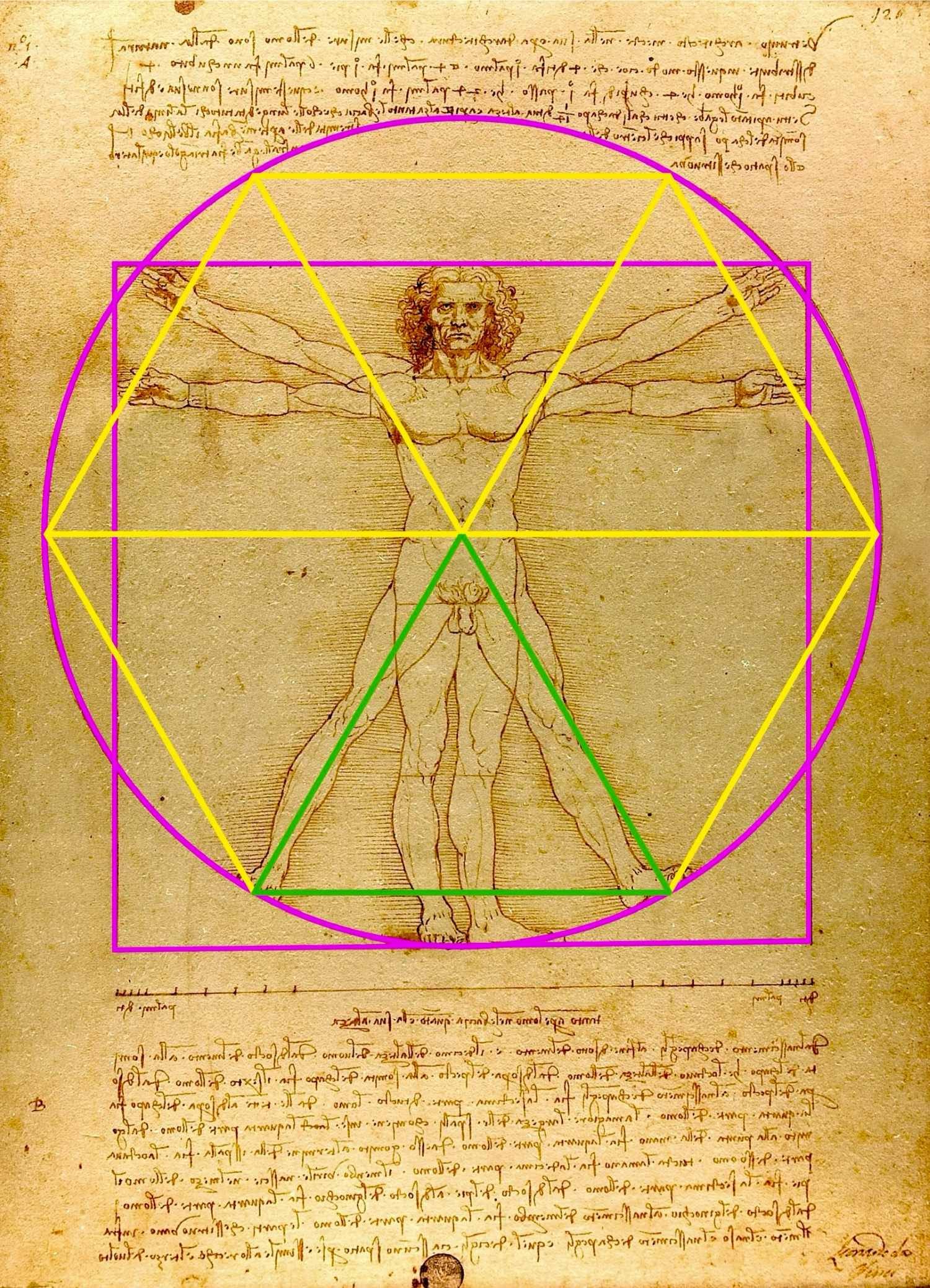
Leonardo’s drawing of about 1490 is one response to the problem, and it is where almost every subsequent attempt has begun: measure the sheet, then look for a construction that reproduces the measurement. On the drawing, the side of the square divided by the radius of the circle comes out around 1.64 to 1.65.
Dr Mac Sweeney’s work runs in the other direction. Rather than working backwards from the drawing, it takes the problem as stated and asks what geometry the specification already contains.
Posed that way, the puzzle stops being about the human body at all. The circle is a radial system; the square is an orthogonal one; neither fixes the other’s measure. The body’s role is to be common to both — so the question becomes what geometric figure could stand in its place, belonging to both frames at once.
The specification supplies one. Alongside the drawing, Leonardo wrote that the space between the opened legs forms an equilateral triangle. Beyond the circle and the square themselves, that triangle is the only geometric figure the text names — and it is a figure the circle produces of itself, since a chord equal to the radius subtends exactly a sixth of the circle.
Completing the problem from that triangle, and from nothing imported from outside, gives a proportion of √(8/3) ≈ 1.633, together with a leg splay of 30°. Leonardo’s sheet measures around 1.64 to 1.65. The claim is not that this is the closest fit available — several other constructions sit nearer. It is that this one is built only from the geometry the specification itself provides.
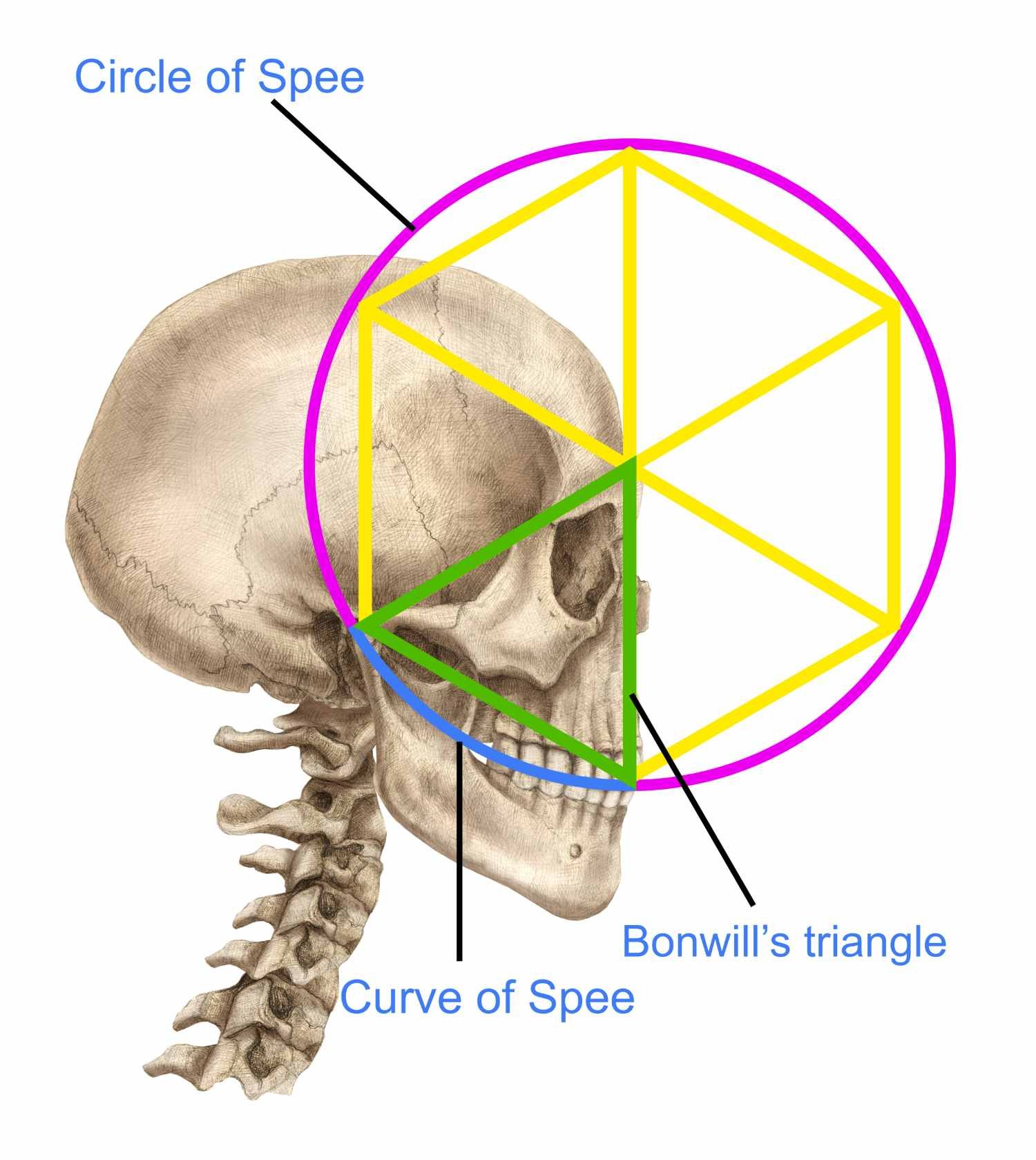
The same ratio recurs elsewhere: it is the edge-to-circumradius ratio of the regular tetrahedron, and the axial ratio of hexagonal close packing. An earlier paper (Journal of Mathematics and the Arts, 2025) traces a related appearance in craniofacial geometry, where the equilateral triangle Leonardo named in 1490 resembles Bonwill’s triangle — a foundational construct in the geometry of dental occlusion, not formally described until 1864.