THE LEONARDO PROJECT
How do you fit a human body into both a circle and a square?
A candidate geometric solution to the Vitruvian problem, and the ratio √(8/3).
The problem
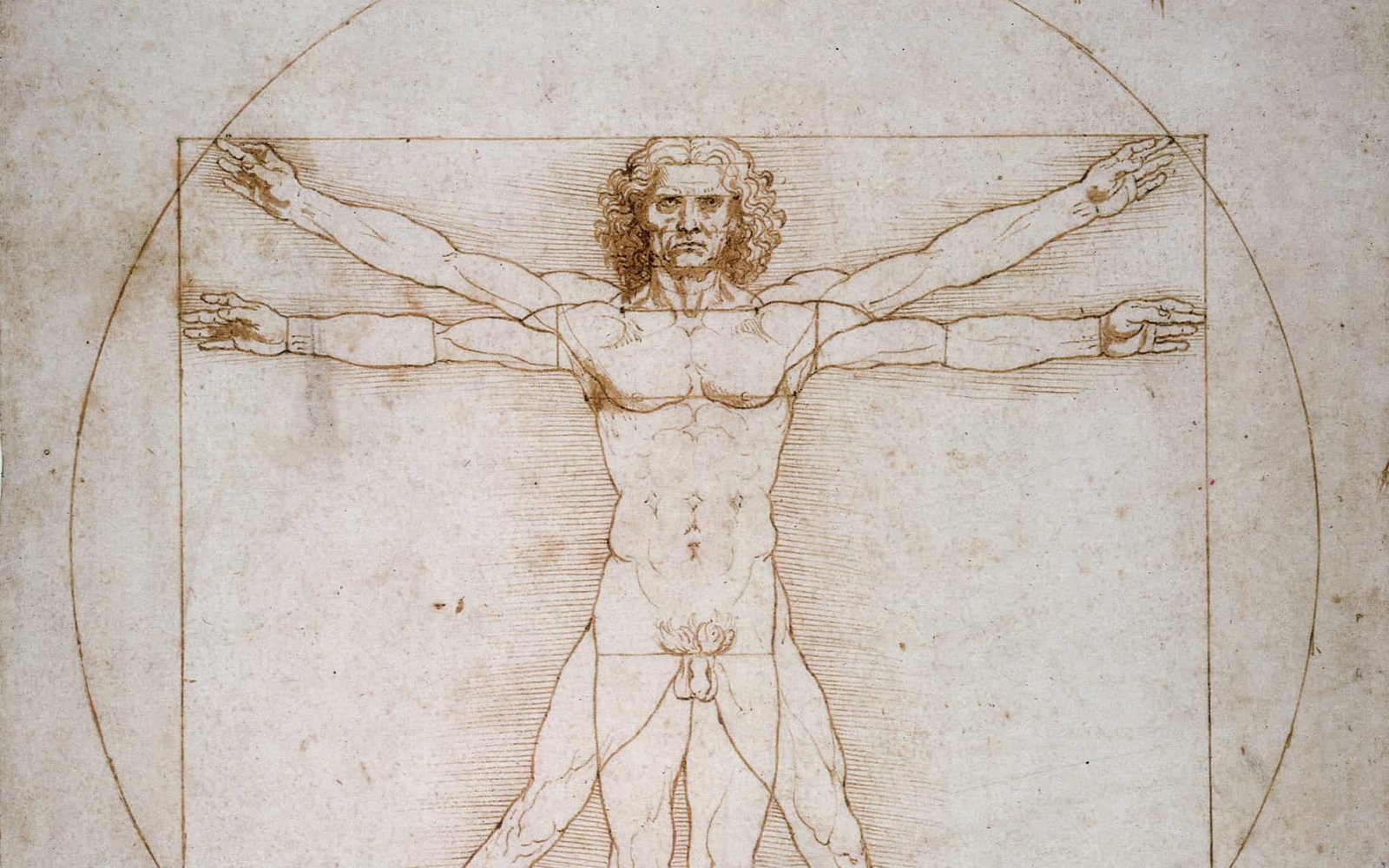
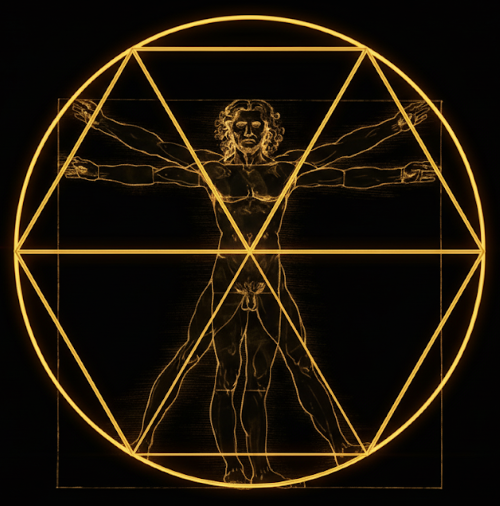
Around 1490 Leonardo drew a man inscribed at once in a circle and a square. The two enclosures are not concentric: the circle is centred on the navel, the square lower. Measured from the sheet, the side of the square divided by the radius of the circle comes out at roughly 1.64–1.65.
But Vitruvius, who set the puzzle fifteen centuries earlier, never specified how the two shapes should relate. Without that, the problem has no single answer — which is why more than a century of analysis has produced construction after construction and no consensus.
Reframing the question
Almost every attempt has worked backwards from the finished drawing: measure the sheet, then find a construction that reproduces the measurement. The difficulty is that reproducing a number doesn’t explain a relationship. Several constructions land close to the drawn value, and the closest of them do so by introducing a figure — an octagon, a heptagon, a vesica — that appears nowhere in the Vitruvian text. Closeness then measures how well an imported figure has been fitted, not whether the circle–square relation has been accounted for.
There is a further difficulty. Leonardo’s square is slightly skewed, and his circle is not a single circle but a series of arcs struck from slightly different centres. A construction inferred by working backwards from such a sheet inherits its irregularities: whatever is idiosyncratic in the execution is carried into the account of the intention.
This work runs in the opposite direction. Rather than starting from the drawing, it starts from the written specification and asks what geometry that specification already contains.
Posed that way, the puzzle stops being about the human body. The circle is radial — everything referred to a centre. The square is orthogonal — everything referred to perpendicular axes. Neither fixes the other’s measure, and the body’s role in the specification is simply to be common to both. So the body can be set aside, and the question becomes structural:
What figure can stand in the body’s place — belonging to the radial system, and carrying a measure against which the orthogonal system can be read?
Two conditions, then. The figure must belong to the circle without being imported into it, and it must possess a characteristic ratio the square can be set against.
The equilateral triangle satisfies both. A chord equal to the radius subtends 60°, so the equilateral triangle is the circle’s own division of itself — not laid over the circle but produced by it. And it carries an intrinsic altitude-to-side ratio against which the square’s diagonal-to-side ratio can be compared.
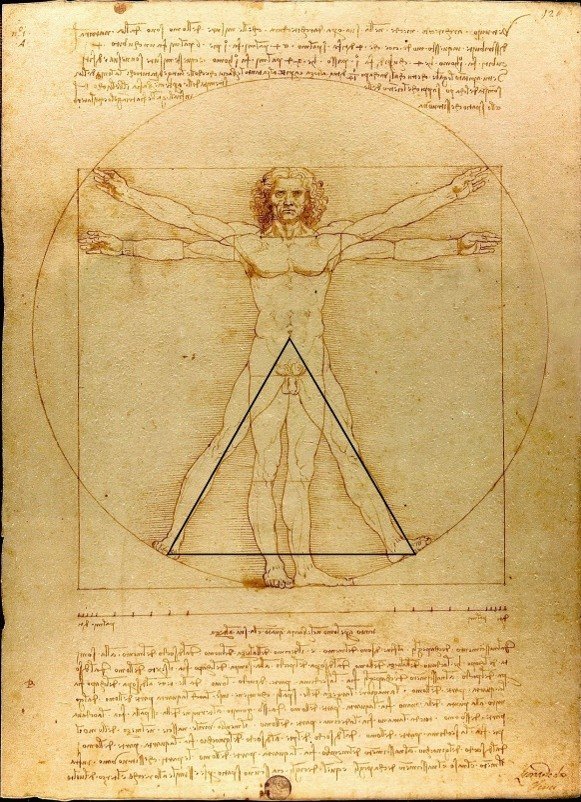
It is also the figure the specification names. Alongside the drawing, Leonardo wrote that the space between the spread legs forms an equilateral triangle. Beyond the circle and the square themselves, that triangle is the only geometric figure the text names.
The derivation
Two shapes built on a shared unit can be compared directly. On a common length r:
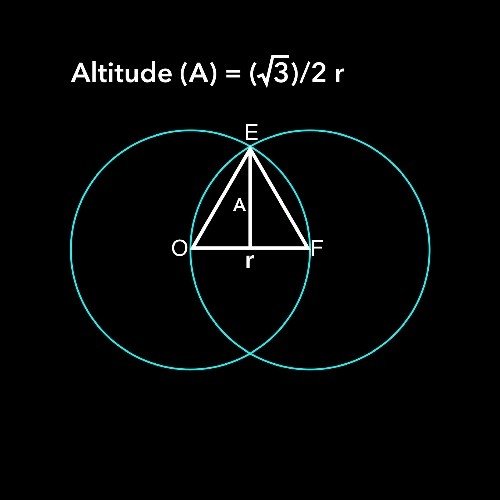
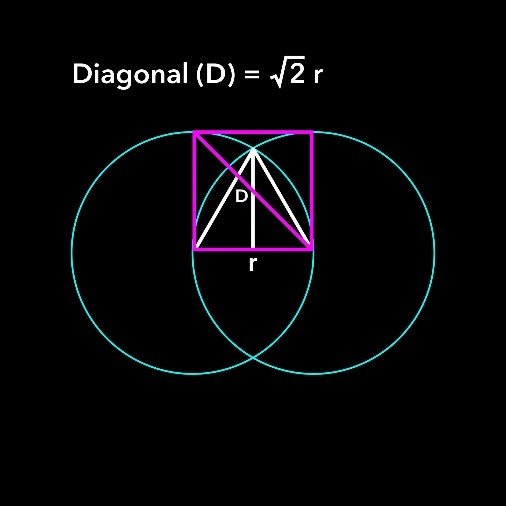
- the equilateral triangle of side r has altitude A = (√3/2)·r
- the square of side r has diagonal D = √2·r
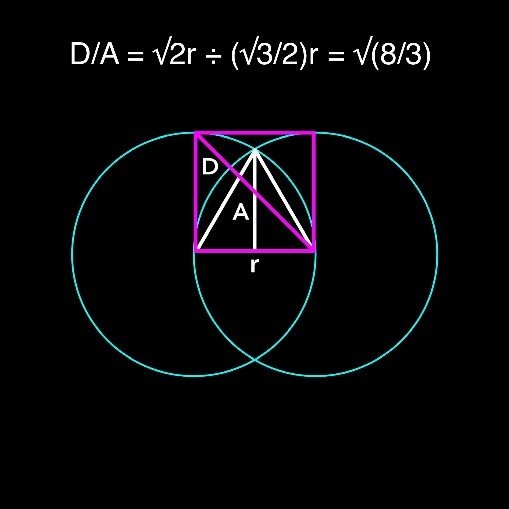
The ratio of the orthogonal measure to the triangular measure is exactly:
D / A = √2 ÷ (√3/2) = 2√2/√3 = √(8/3) ≈ 1.633
The shared length cancels. What remains is a comparison between the two figures’ internal measures — properties of being a square and being an equilateral triangle, independent of size.
(a)
(b)
(c)
(d)
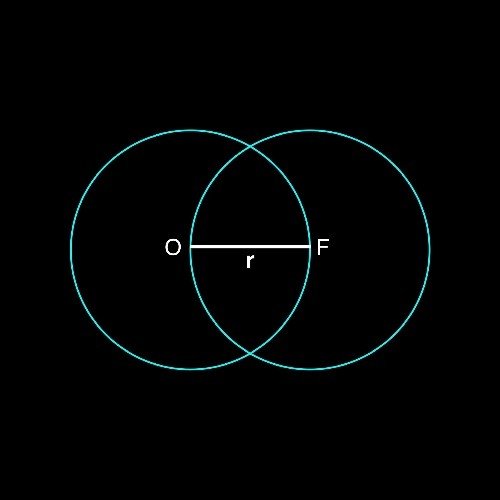
Figure 1 — vesica piscis construction, four panels (a)–(d)
(The vesica piscis is used here only as a familiar Euclidean setting in which all three figures can be built on one unit — a demonstration of constructibility, not a claim about Leonardo’s hand, and not the double-vesica construction proposed by Murtinho.)
√(8/3) is the exchange rate between an orthogonal organisation and a triangular one when both are built on the same unit.
Carrying that to the figure takes one further step, and it is a choice rather than a consequence: the triangle has to be placed. Leonardo’s note names the triangle but does not fix where its vertices fall. Two of the three are given — the specification puts the feet on the circle in the spread position, so both base vertices stand at distance r from the navel. What remains is the apex, and it is identified with the navel because the navel is already the circle’s centre, and so the only point the specification supplies. A crotch apex would require a point the text never names.
The triangle’s side then equals the circle’s radius, which puts the same ratio between the square’s side and the circle’s radius, and sets the legs at 30° from vertical.
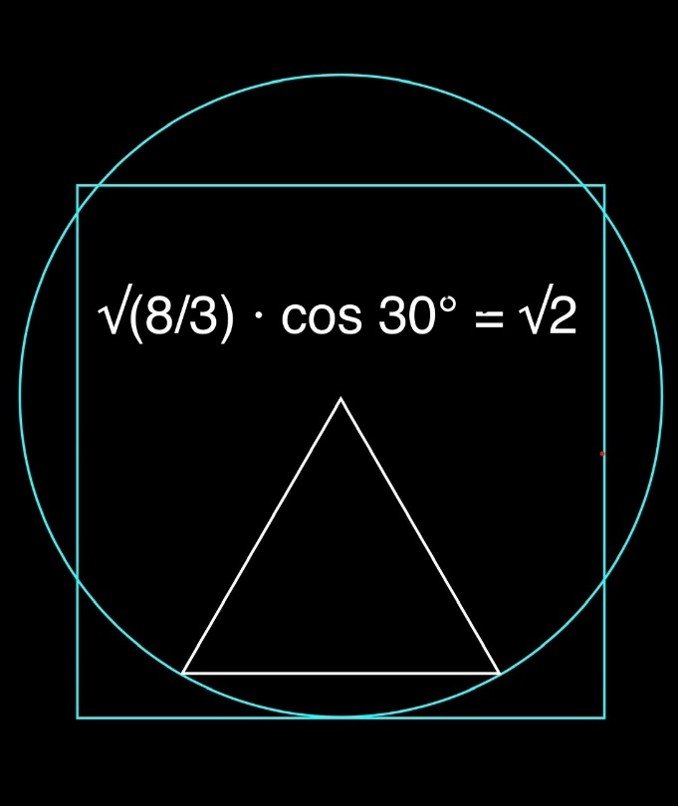
The three measures sit in a single identity:
√(8/3) · cos 30° = √2
The ratio, the angle and the square’s diagonal are three faces of one relationship: fix any two and the third follows.
(a)
(b)
[Figure 2 — (a) the equilateral triangle Leonardo named, drawn onto the figure: apex at the navel, base across the spread feet, legs at 30° from vertical; (b) the same configuration as pure geometry — circle, square and triangle — related by √(8/3) · cos 30° = √2. The body is a stand-in for the geometric figure; the triangle is the same in both.]
How close is it?
Published measurements of the drawing differ. Murtinho (2015) gives a square of 181.5 mm and a radius of 110 mm — a ratio of 1.650. Ida (2012) concludes 1.642. Two careful measurements of one sheet, half a per cent apart. Against these, √(8/3) ≈ 1.633 sits between 0.6% and 1.0% low.
It is worth being plain that this is not the closest available fit. A double vesica, a regular octagon, and a rotation of the arms all land nearer the drawn circle than this construction does. Each achieves that by bringing in a figure the text never mentions. The claim here isn’t that this account matches the sheet best — it’s that it is built only from geometry the specification itself supplies.
Why the same ratio recurs?
√(8/3) isn’t specific to this drawing. It is what the orthogonal–radial relationship costs whenever both are built on a shared unit, so it reappears wherever the same reconciliation arises.
Tetrahedral geometry. For a regular tetrahedron of edge a and circumsphere radius R, a/R = √(8/3).
Close-packed crystals. In the hexagonal close-packed cell, c/a = √(8/3) exactly — the textbook close-packing ratio, seen in magnesium, zinc and titanium. That this packing is the densest possible was conjectured by Kepler in 1611 and proved by Thomas Hales in 1998, with a formal computer-verified proof completed in 2014.
(Hales proved the packing’s optimality. The ratio itself is elementary geometry — what his proof establishes is that this is the arrangement worth caring about.)
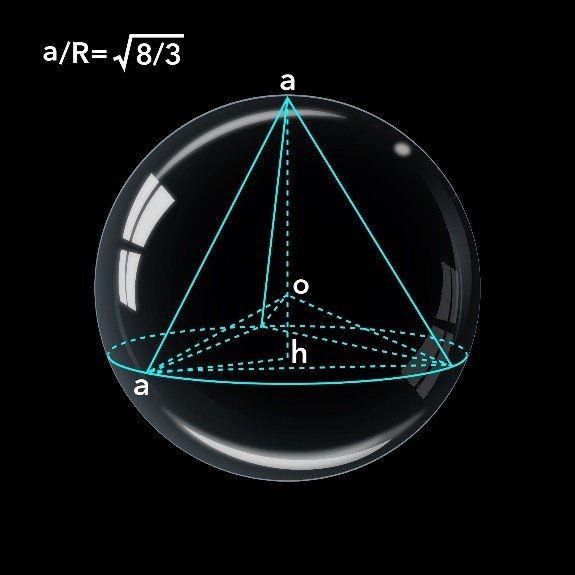
(a)
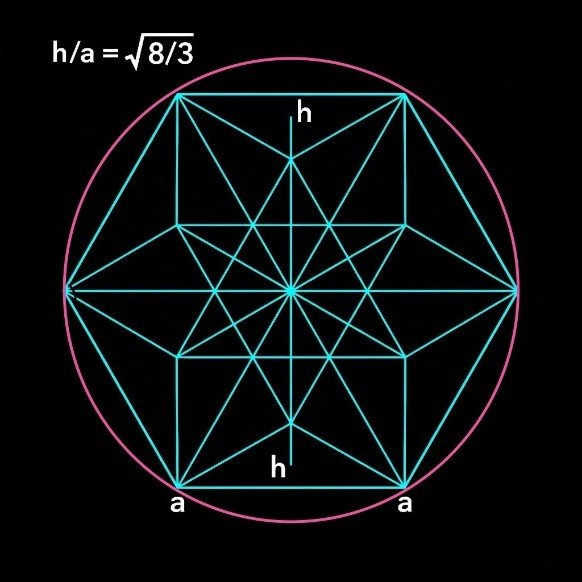
(b)
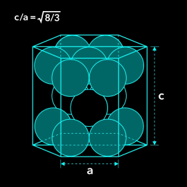
(c)
[Figure 3 — (a) a/R tetrahedron, (b) c/a close-packing]
[Figure 3 — (a) the regular tetrahedron in its circumsphere, a/R = √(8/3); (b) the vector equilibrium, where the radial, orthogonal and triangular components meet on one length; (c) the hexagonal close-packed cell, c/a = √(8/3).]
What is claimed, and what is not?
Mathematical fact. √(8/3) is exactly the tetrahedral edge-to-circumradius ratio and exactly the ideal hexagonal close-packing axial ratio. These are not in dispute.
Proposed. That the equilateral triangle is the figure with which the proportion can be settled from within the specification — and that solving the problem from it, rather than fitting a construction to the drawing, is a different and prior kind of answer. Whether Leonardo arrived at his proportions by observation, inherited convention, or construction is left entirely open. No claim is made about his method or intent.
Not claimed. That this is the only solution available, that the geometry forces it, or that it fits the drawing better than its rivals. It doesn’t — and that is the point: the drawing is something to be accounted for, not the standard by which accounts should be judged.
The Discovery
The Constraint That Made the Impossible Possible
For 1,500 years, Vitruvius’s challenge remained unsolved: how does a circle relate to a square when both must accommodate the human body? Renaissance artists before Leonardo attempted various solutions—all required distorting the figure to fit.
Leonardo solved it with a single geometric specification:
“the space between the legs will be an equilateral triangle.”
This isn’t decorative description—it’s the mathematical constraint that makes Vitruvius’s under-determined problem fully solvable. An equilateral triangle introduces triangular (√3) symmetry. The square provides orthogonal (√2) symmetry. Their reconciliation yields a unique ratio:
√(8/3) ≈ 1.633
Measured from Leonardo’s original drawing: 1.64-1.65—within 1% of the theoretical value, matching the tolerance of hand-executed Renaissance construction.
Leonardo’s systematic studies of hexagonal circle patterns in the Codex Atlanticus prove he was investigating the geometric relationships that generate this ratio. The construction could be executed entirely with compass and straightedge—the tools of Euclidean geometry Leonardo mastered.
The Geometric Construction
How Leonardo Could Have Built It
Using only documented Renaissance techniques:
Step 1: Draw circle with center O, radius r
Step 2: Construct the equilateral triangle
- Mark point on circle, draw another circle of radius r from that point
- Circles intersect, forming equilateral triangle (all sides = r)
- Triangle altitude = (√3/2)·r
Step 3: Construct the √2 relationship
- Draw perpendicular lines of length r
- Hypotenuse = √2·r (by Pythagorean theorem)
Step 4: Combine the proportions
- Using proportional division (documented in Euclid’s Elements and Pacioli’s Summa Arithmetica, 1494)
- Construct ratio: √2·r / [(√3/2)·r] = (2√2)/√3 = √(8/3)
Step 5: Apply to the square
- Use this segment as the square’s side length
- Construct square using standard perpendiculars
This protocol uses exclusively techniques available to Leonardo. Every operation appears in documented Renaissance practice. The ratio emerges not from numerical calculation but from geometric necessity.
The Universal Principle
Why This Ratio Appears Everywhere
√(8/3) isn’t specific to Leonardo—it’s fundamental to how discrete structure relates to continuous fields.
In three dimensions:
For any regular tetrahedron with edge length a and circumsphere radius R:
a/R = √(8/3)
This is the minimum relationship—the tetrahedron is the simplest 3D polyhedron (four vertices defining volume), and this ratio expresses how it necessarily relates to its spherical boundary.
In optimal packing:
When spheres pack at maximum density (hexagonal close packing):
c/a = √(8/3)
where c = vertical spacing, a = horizontal spacing
This isn’t approximate—it emerges necessarily from tetrahedral packing geometry. Nature instantiates this in zinc, cadmium, and magnesium crystal lattices.
In biological architecture:
Human jaw function organizes around Bonwill’s equilateral triangle (established 1864). When extended to Monson’s spherical theory (1920), the mandibular tetrahedron to functional sphere ratio = 1.633.
The jaw evolved to distribute masticatory forces efficiently. Efficient force distribution follows geometric necessity.
In Fuller’s tensegrity:
The Vector Equilibrium—where eight tetrahedra arrange around a common center—achieves perfect geometric balance through this ratio. It represents optimal spatial organization where tension and compression equilibrate.
Leonardo’s 2D construction and Fuller’s 3D lattice solve the same problem: reconciling triangular and orthogonal symmetries in equilibrium.
Why It Matters
Geometric Necessity, Not Aesthetic Choice
This discovery connects:
- Renaissance geometry with contemporary crystallography
- Artistic construction with biological optimization
- Human proportions with universal packing principles
Leonardo wasn’t creating idealized proportions through aesthetic intuition. He was documenting, through geometric construction, the mathematical relationships that govern optimal spatial organization.
The same ratio that appears in his drawing:
- Governs atomic-scale crystal structures
- Defines optimal human craniofacial architecture
- Underlies Fuller’s principles of structural efficiency
- Emerges wherever discrete elements achieve equilibrium within continuous fields
This isn’t numerology finding patterns in noise—it’s geometry revealing the constraints that optimization must satisfy. When biological systems evolve for efficiency, when crystals grow to minimize energy, when Leonardo constructs to reconcile symmetries, they converge on the same mathematical solution.
Form follows geometric necessity. Leonardo saw it through art. Nature proves it through evolution. Mathematics explains why both must converge.
THE LEONARDO PROJECT
The Discovery
The Constraint That Made the Impossible Possible
For 1,500 years, Vitruvius’s challenge remained unsolved: how does a circle relate to a square when both must accommodate the human body? Renaissance artists before Leonardo attempted various solutions—all required distorting the figure to fit.
Leonardo solved it with a single geometric specification:
“the space between the legs will be an equilateral triangle.”
This isn’t decorative description—it’s the mathematical constraint that makes Vitruvius’s under-determined problem fully solvable. An equilateral triangle introduces triangular (√3) symmetry. The square provides orthogonal (√2) symmetry. Their reconciliation yields a unique ratio:
√(8/3) ≈ 1.633
Measured from Leonardo’s original drawing: 1.64-1.65—within 1% of the theoretical value, matching the tolerance of hand-executed Renaissance construction.
Leonardo’s systematic studies of hexagonal circle patterns in the Codex Atlanticus prove he was investigating the geometric relationships that generate this ratio. The construction could be executed entirely with compass and straightedge—the tools of Euclidean geometry Leonardo mastered.
The Geometric Construction
How Leonardo Could Have Built It
Using only documented Renaissance techniques:
Step 1: Draw circle with center O, radius r
Step 2: Construct the equilateral triangle
- Mark point on circle, draw another circle of radius r from that point
- Circles intersect, forming equilateral triangle (all sides = r)
- Triangle altitude = (√3/2)·r
Step 3: Construct the √2 relationship
- Draw perpendicular lines of length r
- Hypotenuse = √2·r (by Pythagorean theorem)
Step 4: Combine the proportions
- Using proportional division (documented in Euclid’s Elements and Pacioli’s Summa Arithmetica, 1494)
- Construct ratio: √2·r / [(√3/2)·r] = (2√2)/√3 = √(8/3)
Step 5: Apply to the square
- Use this segment as the square’s side length
- Construct square using standard perpendiculars
This protocol uses exclusively techniques available to Leonardo. Every operation appears in documented Renaissance practice. The ratio emerges not from numerical calculation but from geometric necessity.
The Universal Principle
Why This Ratio Appears Everywhere
√(8/3) isn’t specific to Leonardo—it’s fundamental to how discrete structure relates to continuous fields.
In three dimensions:
For any regular tetrahedron with edge length a and circumsphere radius R:
a/R = √(8/3)
This is the minimum relationship—the tetrahedron is the simplest 3D polyhedron (four vertices defining volume), and this ratio expresses how it necessarily relates to its spherical boundary.
In optimal packing:
When spheres pack at maximum density (hexagonal close packing):
c/a = √(8/3)
where c = vertical spacing, a = horizontal spacing
This isn’t approximate—it emerges necessarily from tetrahedral packing geometry. Nature instantiates this in zinc, cadmium, and magnesium crystal lattices.
In biological architecture:
Human jaw function organizes around Bonwill’s equilateral triangle (established 1864). When extended to Monson’s spherical theory (1920), the mandibular tetrahedron to functional sphere ratio = 1.633.
The jaw evolved to distribute masticatory forces efficiently. Efficient force distribution follows geometric necessity.
In Fuller’s tensegrity:
The Vector Equilibrium—where eight tetrahedra arrange around a common center—achieves perfect geometric balance through this ratio. It represents optimal spatial organization where tension and compression equilibrate.
Leonardo’s 2D construction and Fuller’s 3D lattice solve the same problem: reconciling triangular and orthogonal symmetries in equilibrium.
Why It Matters
Geometric Necessity, Not Aesthetic Choice
This discovery connects:
- Renaissance geometry with contemporary crystallography
- Artistic construction with biological optimization
- Human proportions with universal packing principles
Leonardo wasn’t creating idealized proportions through aesthetic intuition. He was documenting, through geometric construction, the mathematical relationships that govern optimal spatial organization.
The same ratio that appears in his drawing:
- Governs atomic-scale crystal structures
- Defines optimal human craniofacial architecture
- Underlies Fuller’s principles of structural efficiency
- Emerges wherever discrete elements achieve equilibrium within continuous fields
This isn’t numerology finding patterns in noise—it’s geometry revealing the constraints that optimization must satisfy. When biological systems evolve for efficiency, when crystals grow to minimize energy, when Leonardo constructs to reconcile symmetries, they converge on the same mathematical solution.
Form follows geometric necessity. Leonardo saw it through art. Nature proves it through evolution. Mathematics explains why both must converge.